AI Max for Search: the end of exact match on Google Ads?
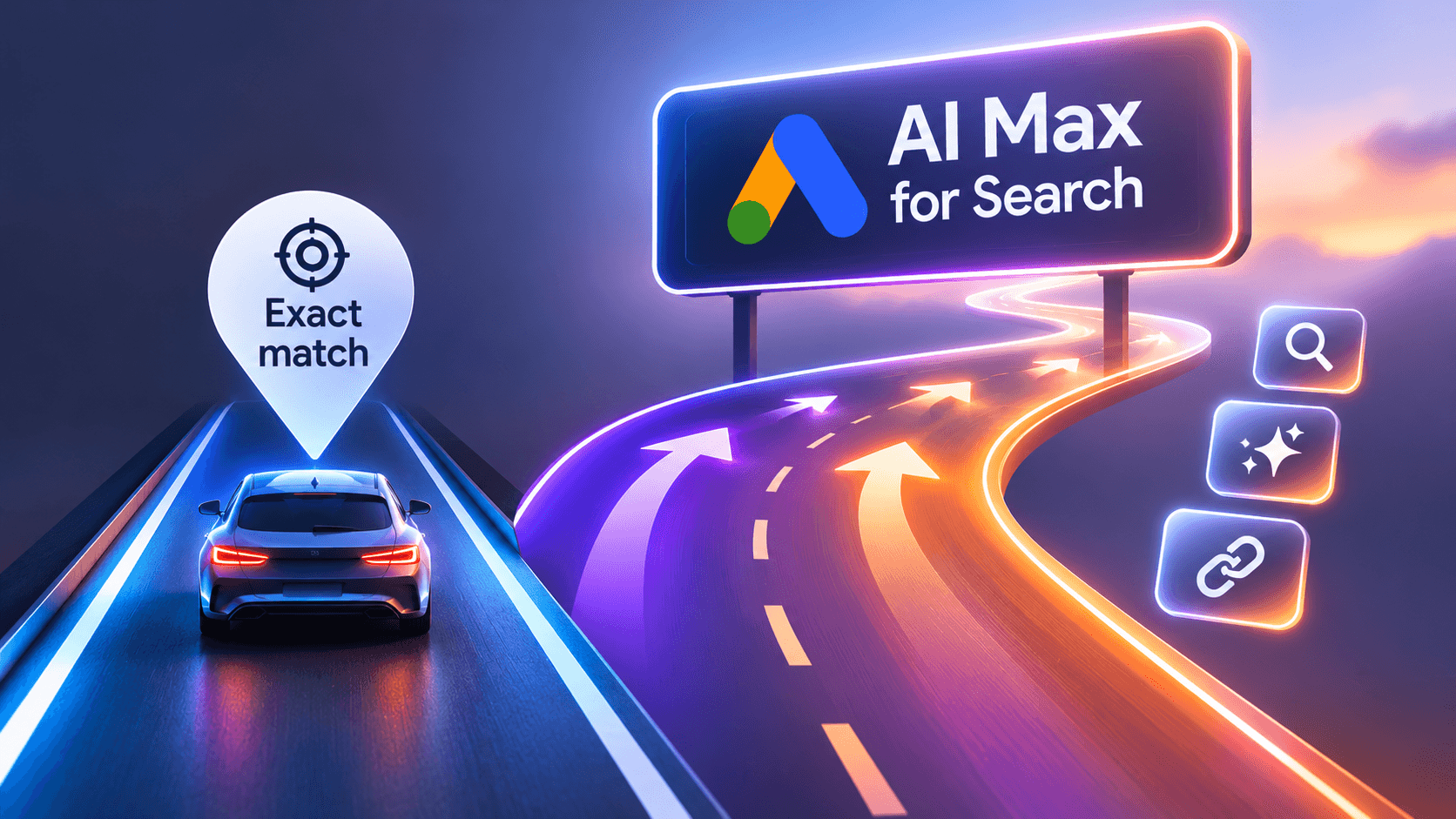
In September 2026, automatically created assets and the campaign-level broad match setting moved to AI Max. In February 2027, Dynamic Search Ads follow. AI Max for Search, announced by Google on 6 May 2025 and out of beta since April 2026, is no longer an option you can ignore. For an account built on exact match, the question is simple: what is an exact match keyword still for when Google finds the queries itself? The answer lies in the keyword prioritisation rules, and in what Google's figures do not show.
What AI Max actually does
AI Max is not a new campaign type. It is a set of three features you switch on in an existing Search campaign, and can turn off one by one.
Search term matching extends delivery beyond your keywords. It combines broad match with "keywordless" matching, which draws on your keywords, your ad assets and the content of your landing pages. It is set, and can be turned off, at ad group level.
Text customisation generates headlines and descriptions from the landing page, your ads and your keywords. It replaces the former automatically created assets feature.
Final URL expansion, also set at campaign level, sends the user to the page of your site that Google considers most relevant to the search, instead of the planned final URL. It only works when text customisation is on.
Exact match keeps priority, on one condition
When a search is identical to an exact match keyword in the account, that keyword takes priority over everything else, according to the prioritisation rules in the Google Ads help centre. Phrase match and broad match come next, AI Max expansions included. A well-chosen exact match keyword therefore still triggers the intended ad, with the intended text and page, on the search it targets.
The condition lies in the word "identical". Every variant, rephrasing and long query that matches no exact keyword can be taken by AI Max. And these expansions mostly start from exact keywords: in Smarter Ecommerce's analysis of more than 250 campaigns, reported by Search Engine Journal in March 2026, 80% of AI Max impressions were triggered from exact match keywords, 19.5% from phrase match and 0.4% from broad match. Switching on AI Max in an exact match account turns every exact keyword into a starting point for expansion.
For accounts that used the campaign-level broad match setting, broad keywords are no longer treated as exact for prioritisation once moved to AI Max (added to Google's help centre in September 2026). Add exact match copies for the searches that matter rather than converting broad keywords: conversion wipes their history.
Negative keywords still apply, according to Google. They become the main tool for limiting expansion.
Google's figures, and everyone else's
Google reports 14% more conversions or conversion value at a similar CPA or ROAS, and 27% for campaigns relying mostly on exact and phrase match. The scope is given in a footnote: Google internal data, 2025, non-retail advertisers. These are averages computed by Google on its own campaigns, with its own attribution rules. They do not say how many of those conversions would have happened anyway through another keyword or organic search.
Outside analyses are more mixed. Across the 250-plus campaigns studied by Smarter Ecommerce, conversion value rose 13% at the median, but CPA also rose 16% at the median. ROAS was flat at the median, with very wide dispersion: from +42% to -35% depending on the campaign, and only 22% of campaigns close to target. In November 2025, PPC Land also reported a test in which AI Max's cost per conversion exceeded $100, against about $53 for exact match and $44 for phrase match. The test's method was not published.
In other words, AI Max adds volume, but nothing guarantees that the volume is profitable. On a given account, only a test will tell. A Google Ads experiment that splits traffic between a version of the campaign with AI Max and one without is better than a before/after comparison distorted by seasonality.
The controls advertisers keep
AI Max leaves several safeguards, provided you set them before switching it on:
- brand settings: inclusions at campaign and ad group level, exclusions at campaign level;
- URL inclusions at ad group level and URL exclusions at campaign level, to keep final URL expansion away from low-converting pages (blog, legal notices, job listings);
- locations of interest at ad group level, which also apply to keywordless matches;
- turning off each feature separately: you can keep search term matching without letting Google rewrite your ads, or the other way round.
In a regulated sector, text customisation is the feature to watch: the text shown is no longer entirely the advertiser's.
What you can see after switching it on
The search terms report shows an "AI Max" match type and a "Source" column that separates broad match expansion from keywordless matching. A search terms and ad combinations view shows which ad and which page were served. The assets report shows which assets were added by Google AI.
Google's help centre warns that this report may show fewer results for AI Max and does not count "other search terms": visibility remains incomplete. Google recommends waiting two weeks after activation before changing the campaign, then reviewing search terms every one to two weeks. For an account that spends every day, that is the bare minimum.
Our view
AI Max does not kill exact match. It changes its role: the exact match keyword remains the way to lock in the searches that matter, with the intended ad and page, while expansion takes the rest. The best-prepared accounts in February 2027 will have tested AI Max before the migration, set their brand and URL exclusions, and chosen which searches to keep under control. To judge the added volume, you need measurement that does not rely on Google's attribution alone: that is the subject of Why your ROAS is lying.
Frequently asked questions
Is AI Max mandatory? Not for a standard Search campaign: AI Max can be switched on and off. But Dynamic Search Ads will be migrated to AI Max from February 2027, and automatically created assets and the campaign-level broad match setting moved to it in September 2026.
Does AI Max replace Performance Max? No. AI Max applies to Search campaigns, while Performance Max serves across all of Google's inventory. According to Google, prioritisation between keywords and keywordless matches works the same way in both.
Sources
- Google, Unlock next-level performance with AI Max for Search campaigns, 2025-05-06
- Google France, Maximisez vos performances avec AI Max pour le Réseau de Recherche, 2025-05-06
- Aide Google Ads, Optimiser Google Ads avec AI Max pour les campagnes sur le Réseau de Recherche, 2026-11-23
- Aide Google Ads, Rapports AI Max, 2026-11-23
- Aide Google Ads, Priorisation des mots clés et des groupes d'annonces, 2026-11-23
- Google, Dynamic Search Ads upgrade to AI Max (mis à jour le 11 juin 2026), 2026-04-15
- Google, AI Max myths, 2026-02-01
- Search Engine Roundtable, Google Ads AI Max Keyword Prioritization For Exact Match, 2026-09-01
- Search Engine Journal, What SMEC's data reveals about AI Max performance, 2026-03-05
- PPC Land, Independent tests show AI Max underperforms traditional match types, 2025-11-08
- Search Engine Journal, Google extends Dynamic Search Ads migration deadline, 2026-06-12
Get our 2 articles a week
The best of paid media and applied AI, straight to your inbox. Zero spam, unsubscribe in one click.